Mastering Your Construction Procurement Plan: A Guide to Avoiding Cost Overruns
Let’s face it: construction procurement is where a lot of projects lose money. According to McKinsey, procurement typically accounts for 40 to 70 percent of a construction company’s total spending. We all know the pain points — delayed materials, over-budget purchases, or a bill that shows up and makes you wonder, “How did I miss this?” If you’re running multiple projects, it only gets harder.
But here’s the thing. Cost overruns aren’t inevitable. A good procurement plan can prevent most of them. The problem? Many contractors either skip planning altogether or throw together a half-baked process that falls apart when things get busy.
I’ve been there. When you’re scrambling to get materials or chasing subcontractors for quotes, the last thing you want is more paperwork. But I’ve learned the hard way that a little structure upfront can save you time, money, and a lot of headaches down the road.
Here’s how to build a construction procurement plan that actually works.
1. Start With a Detailed Bill of Quantities (BOQ)
Your procurement plan starts before procurement even happens. It starts with your Bill of Quantities (BOQ). If your BOQ is vague or incomplete, you’re setting yourself up for problems.
A good BOQ should break down the project into clear scopes of work, quantities, and specifications. Don’t just lump everything under generic headings like “concrete” or “plumbing materials.” Be specific. For example, how many cubic meters of M20 grade concrete will you need? What brand of fittings is required? What’s the delivery schedule?
This level of detail isn’t just for you — it’s for your suppliers and subcontractors too. If they don’t know exactly what you need, you’ll get inconsistent quotes and, worse, inconsistent supplies. That’s where costs start slipping through the cracks.
Pro tip: Use a system that links BOQs directly to procurement workflows. For instance, JobNext lets you upload your BOQ and convert it directly into material requisitions (MRs), ensuring nothing gets missed. No more re-entering line items, and no more “I thought we ordered that” moments.
2. Validate Budgets Before You Spend a Dirham
Here’s where many procurement plans fail: they don’t tie purchases to budgets. If you’re not tracking your spending against your project estimate, you’re basically flying blind.
Every material requisition or work requisition (for subcontractors) should be checked against your project’s budget. If it isn’t in the budget, it doesn’t get approved — simple as that. This forces your team to justify out-of-scope expenses before they happen, not after the damage is done.
In my opinion, this step is non-negotiable. It’s the single most effective way to control costs. According to McKinsey, construction companies are doubling down on procurement strategies to better navigate uncertainties and reduce financial risks.
Solution: Use a tool that automates budget validation. JobNext, for example, flags any requisition that exceeds the approved budget. It won’t even let you raise a purchase order (PO) until the budget exception is approved by the right people. That’s the kind of guardrail every contractor needs.
3. Standardize Your Procurement Workflow
If your procurement process changes from job to job — or worse, from person to person — you’re asking for trouble. A standardized workflow ensures consistency, transparency, and accountability.
For materials, this typically looks like:
- Material Requisition (MR): The site team requests materials, specifying quantities, specifications, and delivery timelines.
- Request for Quotation (RFQ): The procurement team sends the MR to multiple vendors to get competitive quotes.
- Purchase Order (PO): The best quote is selected, and a PO is issued to the vendor.
- Material Receipt Note (MRN): Materials are inspected and received at the site. Discrepancies are flagged immediately.
Subcontractor procurement follows a similar process but with work requisitions (WRs) and requests for proposals (RFPs) instead of MRs and RFQs. The key is to have clear approval steps at every stage, so nothing moves forward without proper authorization.
Best Practices:
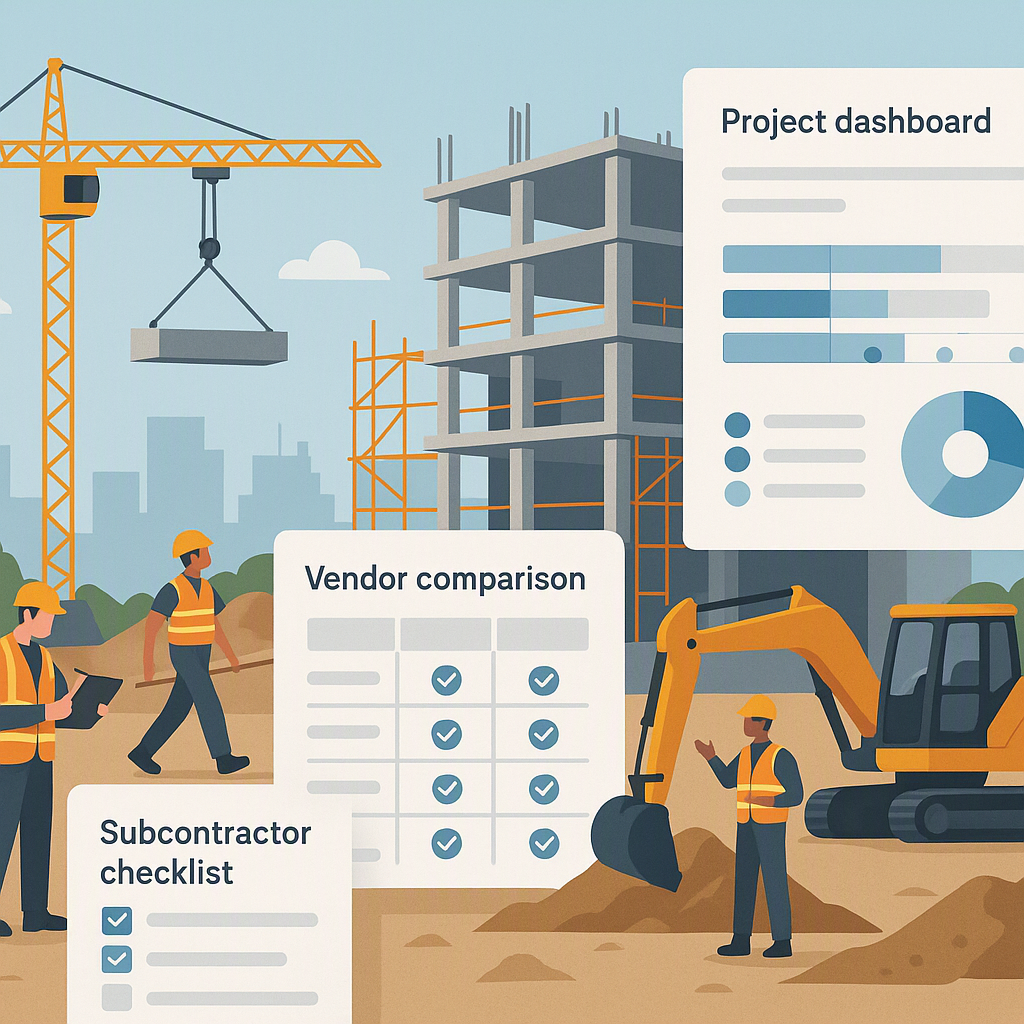
- Always circulate RFQs/RFPs to at least three vendors or subcontractors. According to the "Construction Procurement: A Guide to Purchasing & Logistics," this ensures competitive pricing while also providing the opportunity to assess quality, timelines, and reliability.
- Close the offer window before evaluating bids to maintain fairness and avoid last-minute chaos.
- Document everything. Every MR, RFQ, PO, WR, and RFP should have a clear paper trail.
4. Use Data to Negotiate Better Deals
If you’re not tracking your procurement data, you’re leaving money on the table. Historical data can help you identify which suppliers consistently deliver on time, which ones offer the best prices, and even which materials tend to go over budget.
For example, a survey by McKinsey found that digitized procurement processes enable companies to track performance metrics and uncover inefficiencies. This is critical in an industry where procurement inefficiencies often lead to cost overruns.
One contractor I worked with found that they were consistently overspending on aggregate because they were ordering small quantities from a high-cost local supplier. By consolidating their orders across projects and negotiating bulk discounts, they saved a significant amount.
How to do it: Modern ERP systems like JobNext make this easy. Every MR, RFQ, and PO is logged in the system, so you can pull up reports on vendor performance, price trends, and even stock aging. Use this data to negotiate better terms or switch to more reliable suppliers.
5. Plan for Contingencies
Even the best procurement plan can’t account for every variable. Prices fluctuate. Suppliers miss delivery deadlines. A sudden design change can throw your entire plan out the window.
That’s why it’s crucial to build contingencies into your procurement plan. This could mean:
- Including a buffer in your budget for price increases.
- Pre-qualifying backup suppliers for critical materials.
- Staggering deliveries to reduce storage costs and risks.
Tip: JobNext’s procurement module supports multi-supplier RFQs, so you can always have a backup plan without doubling your workload. And with real-time dashboards, you’ll know immediately if a delay or cost increase is putting your project at risk.
Common Mistakes to Avoid
- Skipping the Budget Step: If you’re not tying procurement to your budget, you’re not really in control of your costs.
- Relying on Verbal Approvals: Always document approvals. It’s the only way to hold people accountable.
- Chasing the Lowest Price: Sometimes the cheapest supplier ends up costing you more in delays or poor quality.
- Overlooking Logistics: A great deal on materials doesn’t help if they can’t get to your site on time.
- Ignoring Data: Your procurement history is a goldmine of information. Use it.
A solid construction procurement plan isn’t just a nice-to-have — it’s a necessity. The good news is, you don’t have to figure it all out on your own.
If you’re looking to streamline your procurement process, JobNext can help. Our structured procurement workflows, budget validation, and real-time reporting keep your costs under control and your projects on track. Get started free →