What We Used to Think About Project Failures
Structural failures are often attributed to obvious culprits: bad materials, poor workmanship, or rushed timelines. It’s convenient to blame a single faulty beam or a contractor cutting corners. For a long time, this was the prevailing mindset—if something fell apart, it was because someone made a mistake.
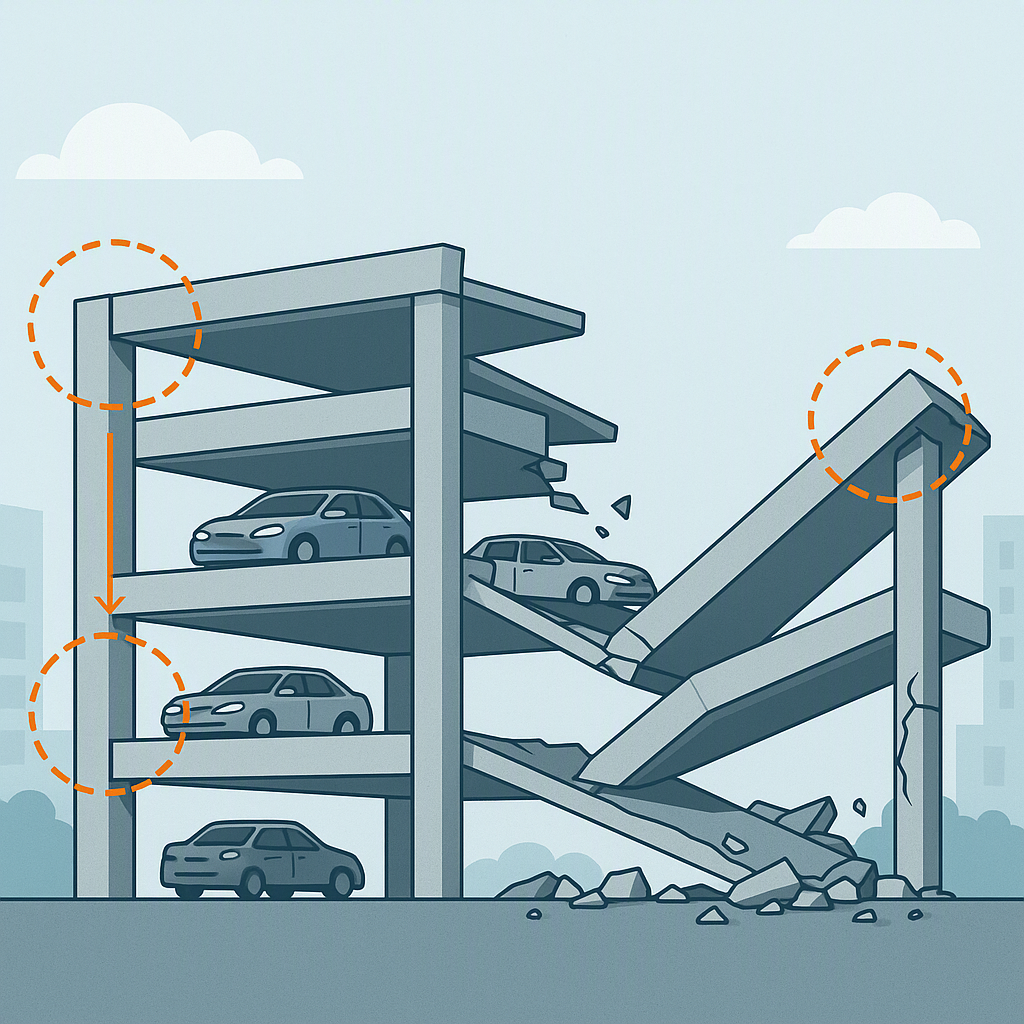
But then, the NYC parking garage collapse happened in April 2023. According to the American Society of Civil Engineers, the project type itself likely contributed to the failure. A parking garage isn’t just another reinforced concrete structure—it comes with unique stressors like dynamic vehicle loads, heavy point loads from parked cars, and exposure to corrosive road salts. These predictable issues weren’t adequately addressed during the design and build phases. This highlighted the importance of tailoring project planning to the specific demands of the project type.
The Shift in Perspective
Contractors often struggle to match their project planning to the unique demands of different project types. For example, a logistics hub might require considerations for high point loads and material handling systems, while a parking garage needs to account for dynamic loads and environmental factors like road salt corrosion. Treating these projects as interchangeable can lead to costly surprises and structural risks.
Why the Old Belief Survived
There’s a reason why contractors rely on standard approaches—they save time. When managing multiple projects simultaneously, it’s tempting to reuse a standard work breakdown structure (WBS) from a similar project. However, this approach overlooks the nuances that differentiate project types. A residential tower isn’t a parking garage, and a parking garage isn’t a logistics hub. Failing to account for these differences can lead to oversights that compromise project integrity.
What We Do Differently Now
A Work Breakdown Structure (WBS) breaks a project into smaller, manageable pieces, ensuring critical steps aren’t overlooked. However, the WBS must reflect the unique challenges of the project type.
Illustrative example — A typical WBS for a parking garage might break tasks down like this:
- Structural Work (Package)
- Foundation (Parent Scope Group)
- Excavation for Footing (Scope)
- PCC for Footing (Scope)
- Reinforcement for Footing (Scope)
- RCC M25 for Footing (Scope)
- Deck Slab (Scope Group)
- Formwork Installation
- Rebar Placement
- Concrete Pouring
- Curing
- Foundation (Parent Scope Group)
By using tailored WBS templates, contractors can ensure they’re not missing critical steps or misestimating costs. For example, a logistics hub’s WBS should account for high point loads and material handling systems. If it doesn’t, the project risks budget overruns and structural issues.
Common Mistakes to Avoid
-
Reusing Generic BOQs: Avoid copy-pasting from previous projects. If your Bill of Quantities (BOQ) doesn’t reflect the unique stresses of the project type, you risk budget overruns or structural failures.
-
Ignoring Environmental Factors: Corrosive road salts in parking garages, seismic activity in high-rise buildings—these factors need to be integrated into the WBS from the start.
-
Rushing Subcontractor Selection: The cheapest bid isn’t always the best. For complex structures, prioritize subcontractors with proven expertise in similar projects. Technical capability should be a key evaluation criterion.
-
Skipping Documentation: Ensure traceability by linking every scope, BOQ, and WBS template back to its source. This prevents critical details from being overlooked and provides an audit trail.
Conclusion
Structural failures like the NYC parking garage collapse are a wake-up call. They remind us that project type isn’t a checkbox—it’s a lens through which every decision, from design to execution, must be viewed. Contractors who rely on cookie-cutter approaches risk compromising project integrity.
Tailored WBS templates are a great starting point for addressing these challenges. By adapting planning to the specific demands of each project type, contractors can mitigate risks and improve outcomes.