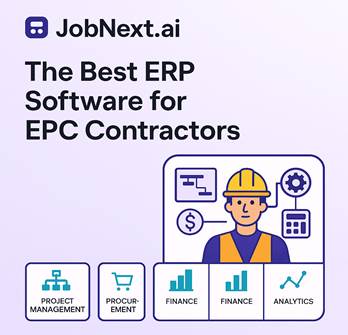
EPC (Engineering, Procurement, and Construction) projects have a cost overrun problem that borders on structural. Industry analysis shows that cost overruns of 20-30% have become embedded in energy infrastructure delivery, and large-scale projects can exceed budgets by up to 80%.
We work with EPC contractors across the Middle East, South Asia, and Africa. The pattern we see repeatedly is not one of incompetence — these are skilled engineers and experienced project managers. The pattern is one of information lag. By the time traditional monthly reporting reveals a problem, the cost has already been incurred. You are not managing the project; you are documenting its failures.
Modern project controls technology changes this equation fundamentally, but only if implemented with an understanding of how EPC workflows actually function.
Why EPC Projects Are Uniquely Vulnerable to Overruns
EPC projects differ from standard construction in ways that amplify cost risk:
Engineering drives everything. In traditional construction, the design is largely complete before construction begins. In EPC, engineering, procurement, and construction overlap significantly. A design change in week 20 cascades through procurement (materials already ordered may be wrong) and construction (work already done may need rework). Research published in Nature identified seven critical drivers with high network centrality: planning issues, estimation inaccuracies, design inefficiencies, weather, scope challenges, contractual ambiguities, and unforeseen site conditions.
Procurement lead times are long. Specialized equipment — transformers, compressors, heat exchangers — may have 26-52 week lead times. A delay in engineering specs means a delay in procurement, which means a delay in construction, which means liquidated damages. The chain reaction can turn a two-week design delay into a three-month project delay.
Multi-disciplinary coordination is constant. Mechanical, electrical, instrumentation, civil, and structural teams must coordinate continuously. When these teams use different tools and different data, coordination failures are inevitable.
Scope definition is inherently uncertain. Unlike repeat-build residential projects, many EPC projects involve first-of-a-kind installations. The scope is defined to the best ability at tender stage, but site conditions, regulatory requirements, and client changes inevitably alter it.
The Technology Shift: From Monthly Reports to Daily Monitoring
Forward-thinking EPC firms are shifting from traditional monthly status reports to daily monitoring systems that flag variances in real-time, enabling proactive intervention before issues escalate. This is not incremental improvement — it is a fundamental change in how project controls operate.
Real-Time Cost Tracking
Traditional approach: Site teams record costs weekly, engineering compiles monthly, project controls produces a cost report 15-20 days after month-end. Total lag: 6-8 weeks.
Modern approach: Field transactions (timesheets, material receipts, equipment usage) flow into the cost system daily. Automated alerts trigger when any cost code exceeds its budget by a configurable threshold. The project manager knows about a cost issue within 24-48 hours, not 6-8 weeks.
Earned Value Management (EVM)
EVM remains the most powerful project controls methodology, but its value depends entirely on data freshness. The three core metrics — Planned Value (PV), Earned Value (EV), and Actual Cost (AC) — produce meaningful insights only when actual costs and progress are current.
An integrated ERP that tracks both cost and progress enables real-time EVM calculations:
- Cost Performance Index (CPI): Are we getting value for the money we are spending?
- Schedule Performance Index (SPI): Are we progressing at the planned rate?
- Estimate at Completion (EAC): Based on current performance, what will this project actually cost?
When EVM data is 6 weeks old, you are forecasting with stale inputs. When it is updated daily, you have a genuine early warning system.
S-Curve Analysis
The S-curve — plotting cumulative cost or progress against time — is a staple of EPC project controls. But static S-curves plotted manually in Excel have limited value. Integrated systems generate live S-curves that overlay planned versus actual versus forecast, instantly revealing whether a project is accelerating, decelerating, or tracking to plan.
The visual power of a live S-curve in a project review meeting — showing exactly when the project diverged from plan and projecting where it will end — changes the quality of decision-making dramatically.
Design Phase Controls: Where the Real Prevention Happens
Having project controls in place during the engineering and design stage eliminates future construction cost overruns. This is the single most under-utilized opportunity in EPC project management.
Design changes after construction begins cost 10-100 times more than changes made during design. Yet many EPC contractors do not apply cost controls until construction starts.
What design-phase cost control looks like:
- Quantity tracking during design development: As engineers develop drawings, quantities are extracted and compared against the estimate. If structural steel quantities are trending 15% above the bid quantities after 60% design completion, that is an early warning that needs immediate attention.
- Specification reviews against budget: When an engineer specifies a more expensive material or equipment than assumed in the estimate, the system flags the budget impact before the specification becomes a purchase order.
- Design freeze milestones: Integrated systems track which design deliverables are frozen, which are still evolving, and quantify the cost risk of ongoing design changes.
Procurement Integration: The Missing Link
In many EPC organizations, procurement operates semi-independently from project controls. Buyers place orders, receiving departments confirm delivery, and the cost team records expenses. The integration between commitment (when you place the PO) and expenditure (when you pay) is loose, creating blind spots.
A 2025 study on EPC cost management found that strategic optimization of cost management through integrated approaches is critical for project success.
An integrated system should track:
- Commitments: The moment a PO is issued, the committed cost appears in the project forecast
- Accruals: Materials received but not yet invoiced are accrued against the budget
- Expenditures: Actual payments update the cost baseline
- Uncommitted budget: The remaining budget available for new purchases
This four-dimensional view of cost — committed, accrued, expended, and available — gives project managers a complete picture at any point in time.
Digital Twins and BIM: The Next Frontier
While not universally adopted yet, digital twins and BIM integration with ERP systems represent the next evolution in EPC project controls. BIM and digital twins ensure the seamless flow of design information across the entire EPC chain and prevent costly information transfer errors.
The vision is powerful: a 3D model of the project linked to the schedule (4D), the cost (5D), and the operational parameters (6D), providing a single source of truth accessible to every team member.
We are not there yet for most mid-market EPC contractors. But the contractors investing in BIM-capable ERP platforms today will be best positioned to leverage these capabilities as they mature.
Practical Steps for Improving EPC Project Controls
If you are an EPC contractor operating with traditional monthly reporting, here is a pragmatic improvement path:
- Start with cost code discipline. Your cost codes must align between estimating, project controls, and accounting. Without this alignment, no technology will help.
- Implement daily time capture. Getting labor costs recorded daily is the single highest-impact change. Mobile time entry tools make this practical even on remote sites.
- Automate commitment tracking. Every PO should automatically update the project cost forecast. This alone eliminates the most common cost surprise in EPC projects.
- Establish variance thresholds. Define what deviation triggers an alert. A 5% variance on a $50K cost code is $2,500 — probably not worth escalating. A 5% variance on a $5M cost code is $250K — that needs immediate attention.
- Implement earned value for major work packages. You do not need to apply EVM to every activity. Focus on the top 20 cost codes that represent 80% of the project value.
The ROI for EPC Contractors
Given that EPC projects routinely overrun by 20-30%, even a partial improvement has enormous value. If integrated project controls reduce overruns by one-third — from 25% to 17% — on a $100 million project, that is $8 million in recovered margin.
Against that, the technology investment is rounding error. The real investment is in the discipline, processes, and cultural change to use the technology effectively.
The EPC contractors who figure this out will not just survive — they will win the projects that demand transparency, accountability, and demonstrable project controls capability.
Ready to see JobNext in action?
Multi-tenant SaaS ERP for construction, facilities management, and contracting — covering preconstruction, project execution, procurement, HR & payroll, equipment, finance, and 150+ analytics reports.
Get Started Free →