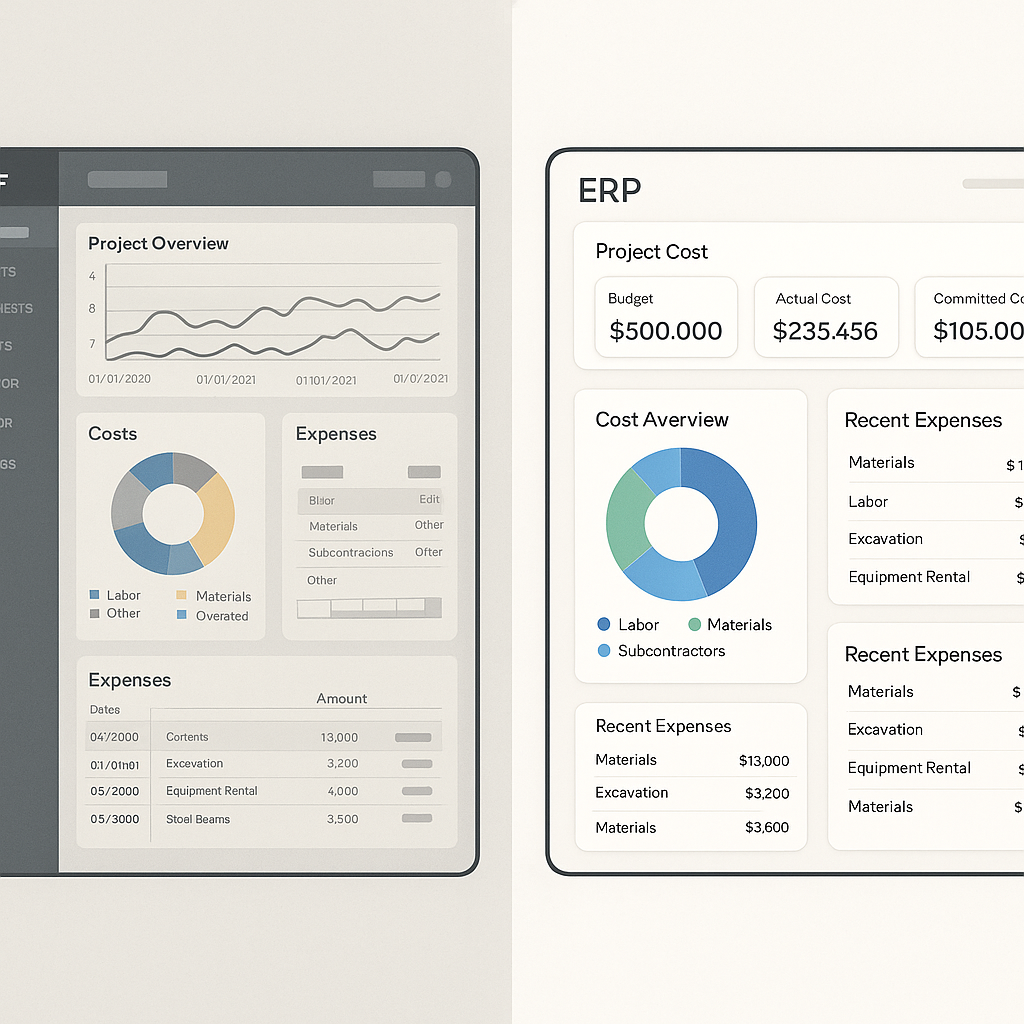
Why Your ERP Might Be Costing You More Than It Saves
Let’s face it—ERP systems are supposed to simplify your life. But if you’re using a legacy system like CMiC, you’ve probably noticed the cracks. Especially when it comes to real-time project profitability tracking. For contractors in India and GCC, this isn’t just a “nice-to-have.” It’s survival.
Margins are razor-thin in our industry. A single project running over budget can wipe out months of profit. Yet, many ERP systems—including CMiC—don’t give you the tools to monitor costs as they happen. Instead, you’re stuck reconciling numbers at the end of the month, long after the damage is done.
The Real Cost of Poor Cost Tracking
Here’s a scenario I’ve seen too often: A contractor wins a bid based on a competitive Bill of Quantities (BOQ). Sounds great, right? But two months into the project, they realize they’ve blown through 70% of their budget with only 50% of the work completed. Why? Because their ERP didn’t alert them to cost overruns in real time.
This isn’t just anecdotal. According to a 2023 McKinsey report, 80% of construction projects experience some form of budget creep. The main culprit? Lack of visibility. You can’t fix what you can’t see.
Real-World Example: A UAE Contractor's Struggle
One UAE-based contractor shared their story. They had been using CMiC to manage an infrastructure project worth ₹50 crore. Because their ERP didn’t offer real-time insights, they discovered a ₹1.2 crore budget overrun only after reconciling expenses at the end of the quarter. By then, vendor contracts were locked in, and the damage was irreversible.
Contrast that with modern ERP users who can catch these issues early. One contractor in Dubai reported that using a platform like JobNext allowed them to flag a ₹15 lakh overrun just days after it occurred, giving them time to negotiate better rates with their suppliers.
What Modern Alternatives Do Differently
Modern ERPs like JobNext tackle this head-on. Real-time tracking isn’t just a feature—it’s the backbone of the system. Here’s how it works:
- BOQ-Level Monitoring: JobNext tracks every expense against your Bill of Quantities (BOQ) so you know exactly where your money is going. For example, if a ₹5 lakh line item for steel is exceeded, the system alerts you immediately, ensuring you don’t overspend.
- Alert Mechanisms: The system flags budget overruns immediately, not weeks later when it’s too late to course-correct. Imagine receiving an alert on your mobile the moment a subcontractor's invoice pushes your project over budget.
- Integrated Workflows: Whether it’s procurement, subcontractor payments, or equipment hire, every transaction is validated against approved budgets. This eliminates manual errors and ensures compliance with financial controls.
Case Study: Annual Savings with Real-Time Tracking
One medium-sized contractor in India shared their results after switching to JobNext. By catching cost overruns early, they saved ₹25 lakh in the first year alone. This was primarily due to better vendor negotiations and avoiding unnecessary purchases.
Why CMiC Falls Short
CMiC is a solid system for general project management, but it wasn’t built with the specific needs of Indian and GCC contractors in mind. Here’s why:
- VAT/GST Compliance: CMiC doesn’t natively support dual GST for Indian operations or VAT for GCC countries. Contractors often resort to external tools for compliance, which increases complexity and costs.
- Approval Workflows: Many contractors need multi-level approvals for purchases and payments. CMiC’s workflows are rigid compared to modern platforms like JobNext, which allow for customizable approval hierarchies.
- Real-Time Insights: Most CMiC users rely on monthly or weekly reports, which are often outdated by the time they’re reviewed. This delay can lead to missed opportunities for corrective action.
Comparison Table: CMiC vs. JobNext
| Feature | CMiC | JobNext |
|---|---|---|
| Real-Time Cost Tracking | No | Yes |
| GST/VAT Compliance | Limited | Full Support |
| Multi-Level Approvals | Basic | Advanced |
| Mobile Alerts | No | Yes |
| Cloud Scalability | Limited | Full SaaS |
The Case for Real-Time Profitability Tracking
Let’s break it down:
-
Scenario 1: Without Real-Time Tracking
Your team approves a ₹10 lakh material purchase without realizing the project is already 20% over budget. By the time the finance team flags it, the materials are on-site, and you’re stuck. -
Scenario 2: With Real-Time Tracking
JobNext alerts your project manager before the purchase is approved, showing that the expense exceeds the allocated budget. You renegotiate with the vendor or adjust the scope to stay on track.
Which scenario would you prefer?
Actionable Steps to Implement Real-Time Tracking
- Audit Your Current ERP: Identify gaps in features like cost tracking, reporting, and compliance.
- Set Up Alerts: Use an ERP that allows customizable alerts for budget overruns.
- Train Your Team: Ensure project managers and finance teams know how to use real-time tracking tools effectively.
Common Objections to Switching ERPs
You might be thinking, “Switching ERPs is a nightmare.” And you’re not wrong—it can be. But staying with a system that doesn’t meet your needs is worse.
Here’s how modern systems like JobNext make the transition easier:
- Data Migration: Tools like Tally integration and opening balance uploads simplify the migration process.
- User Training: Platforms like JobNext offer dedicated onboarding support, so your team isn’t left in the dark.
- Scalable Architecture: Multi-tenant SaaS platforms ensure you’re always on the latest version without manual updates.
What’s the ROI?
Still not convinced? Let’s talk numbers. Contractors using JobNext report:
- 10-15% Savings: By catching cost overruns early.
- 20-30% Faster Approvals: Thanks to automated workflows.
- Zero Revenue Leakage: With enforced billing methods.
When you’re running projects worth crores, these savings add up fast.
FAQ
1. Can JobNext handle multi-site operations?
Yes, it offers features like attendance, payroll, and cost allocation tailored for multi-site projects.
2. What about compliance with Indian and GCC regulations?
JobNext supports dual GST, GCC VAT, and statutory deductions like PF and ESI.
3. How does JobNext ensure data security?
It’s a multi-tenant SaaS platform with role-based access and complete data isolation.
4. What’s the cost of switching?
Costs vary, but the ROI from improved profitability and compliance often outweighs the investment.
5. How long does it take to implement JobNext?
Implementation timelines vary, but most contractors are fully operational within 4-6 weeks.
The Bottom Line
If you’re using CMiC or another legacy system, you’re leaving money on the table. Modern ERPs like JobNext aren’t just about managing projects—they’re about protecting your margins.