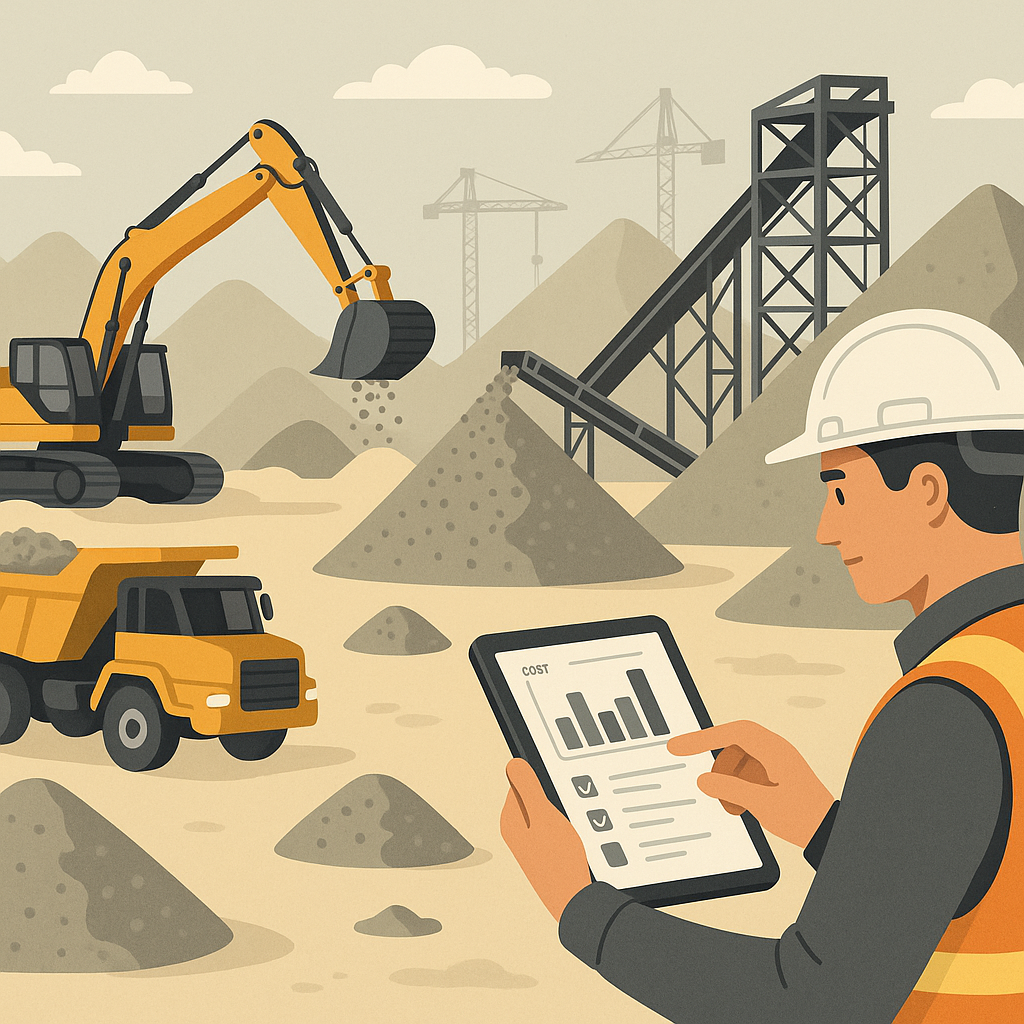
Three years ago, when we suggested cloud ERP to a $40 million contracting firm in Muscat, the operations director pushed back hard. "Our projects are in the desert," he said. "No internet, no cloud." He had a point — in 2022. By 2025, that same firm runs their entire operation on a cloud platform with offline-capable mobile apps. Their field teams sync data whenever they hit connectivity, and nobody has lost a transaction.
The cloud versus on-premise debate in construction ERP is effectively over, but not for the reasons most articles suggest. It is not about cost savings or scalability or any single factor. It is about the cumulative weight of evidence from thousands of implementations.
What the Data Shows
The numbers have become difficult to argue with:
- Companies on cloud ERP report 92% improved profitability vs. 42% on-premise
- Cloud implementations complete 40-60% faster than on-premise deployments
- Organizations migrating to cloud achieved 34% cost reductions over three years
- Cloud solutions reduce total cost of ownership by 30-50% over five years
But we want to be honest about what these numbers represent. The 92% profitability figure does not mean cloud ERP magically makes companies profitable. Companies that adopt cloud systems tend to be more forward-thinking in general, creating a selection bias in the data.
The more defensible claim is this: cloud ERP eliminates an entire category of costs and risks that on-premise systems impose, freeing contractors to focus on building things instead of managing IT infrastructure.
The Case for Cloud (It Is Stronger Than You Think)
No IT Infrastructure Burden
Most contractors are not IT companies. They should not be running server rooms, managing backups, patching operating systems, or worrying about database administration. Yet on-premise ERP requires exactly that.
A mid-size contractor running an on-premise system typically needs one dedicated IT person ($60K-$100K annually) plus hardware refreshes every 3-5 years ($30K-$50K), backup systems, power protection, and physical security. Cloud eliminates all of it.
Automatic Updates
On-premise systems require scheduled downtime for updates, which often get deferred because "we are too busy." We have seen contractors running software versions three years out of date because nobody had time for the upgrade. Those deferred updates become a compounding technical debt that eventually forces a painful — and expensive — upgrade or migration.
Cloud systems update automatically. You always have the latest features, security patches, and performance improvements without lifting a finger.
True Multi-Device Access
This matters enormously in construction. Your estimator works from the office. Your project manager works from the site trailer. Your superintendent walks the jobsite with a phone. Your owner reviews dashboards from a tablet at dinner.
Cloud systems are built for this from the ground up. On-premise systems retrofit remote access through VPNs and remote desktop tools that are clunky, slow, and frequently unreliable from construction sites.
Disaster Recovery Built In
When your server room floods (it has happened to clients of ours), your business stops. When your cloud provider's data center has an issue, they have redundant systems across multiple geographic regions that take over in seconds. The recovery scenarios are not comparable.
The Legitimate Concerns About Cloud (And How They Have Been Addressed)
"What About Connectivity?"
This was the number one objection in 2020. Today, it is largely solved. Modern construction ERPs offer offline-capable mobile apps that cache data locally and sync when connectivity returns. Between cellular networks, site WiFi, and satellite internet options (Starlink is increasingly common on remote projects), connectivity gaps are measured in minutes, not days.
"What About Data Security?"
This concern gets the equation backward. Major cloud providers — AWS, Azure, Google Cloud — invest hundreds of millions annually in security infrastructure, employ thousands of security engineers, and maintain certifications (SOC 2, ISO 27001, GDPR) that no mid-size contractor could achieve independently.
Your on-premise server, accessible to anyone with a key to the office, running an operating system that has not been patched in six months, with backups stored in a drawer down the hall, is almost certainly less secure than a properly configured cloud deployment.
"What About Data Sovereignty?"
For contractors operating in regions with strict data residency requirements — particularly in the GCC — this is a valid concern. The solution is choosing a cloud provider with data centers in your region. Azure, AWS, and Google all have Middle East regions now. Your data can live in the cloud and stay within your country's borders.
"What About Ongoing Costs?"
The subscription model of cloud ERP means costs are spread over time rather than concentrated in a large upfront purchase. Some CFOs dislike this because the expense never goes away. But when you add up the true cost of on-premise — hardware, IT staff, upgrades, maintenance, backup systems, power, and cooling — the five-year total cost of ownership consistently favors cloud by 30-50%.
The Hybrid Middle Ground
It is worth noting that hybrid ERP models have become the dominant approach for large enterprises, blending on-premise and cloud components. This is most common with organizations that have existing on-premise investments they cannot write off immediately.
For a contractor starting fresh — or whose current system has reached end-of-life — there is rarely a compelling case for on-premise in 2025. The hybrid approach makes sense primarily as a transition strategy, not as a permanent architecture.
Migration Without Disruption: A Practical Approach
The fear of migration disruption stops many contractors from making the move. Here is the approach we recommend:
Phase 1: Shadow Run (4-6 Weeks)
Set up the cloud system alongside your existing setup. Enter data in both systems for a controlled period. This reveals data mapping issues, workflow gaps, and training needs without risk.
Phase 2: Module-by-Module Transition (8-12 Weeks)
Move one module at a time, starting with the least disruptive. We typically recommend starting with financial reporting and analytics — your team can use the new dashboards while transactions still flow through the old system.
Phase 3: Core Cutover (2-4 Weeks)
With the team trained and confident, move core transactions (POs, invoicing, time entry) to the cloud system. Keep the old system available in read-only mode for historical reference.
Phase 4: Decommission (4 Weeks)
Once you have completed one full billing cycle on the new system without issues, archive the old system and complete the transition.
The Decision Framework
| Factor | Cloud Wins When... | On-Premise Wins When... |
|---|---|---|
| Budget | You prefer OpEx over CapEx | You have capital but limited recurring budget |
| IT capacity | You have no dedicated IT staff | You have a strong IT department |
| Field access | Multiple sites need real-time access | Single-site operation with local network |
| Growth plans | Rapid scaling expected | Stable, predictable operation |
| Data sensitivity | Standard business data | Classified or heavily regulated data |
For 95% of contractors we have worked with, every factor points to cloud.
The Bottom Line
The question is no longer "cloud or on-premise?" The question is "when and how do we migrate?" Every month you delay is a month of unnecessary IT overhead, limited field access, and deferred updates.
The contractors who moved to cloud two years ago are not looking back. They are looking at their dashboards from a phone on a jobsite, approving purchase orders from an airport lounge, and reviewing project margins before their morning coffee. The technology barrier is gone. The only remaining barrier is the decision to move.
Ready to see JobNext in action?
Multi-tenant SaaS ERP for construction, facilities management, and contracting — covering preconstruction, project execution, procurement, HR & payroll, equipment, finance, and 150+ analytics reports.
Get Started Free →